
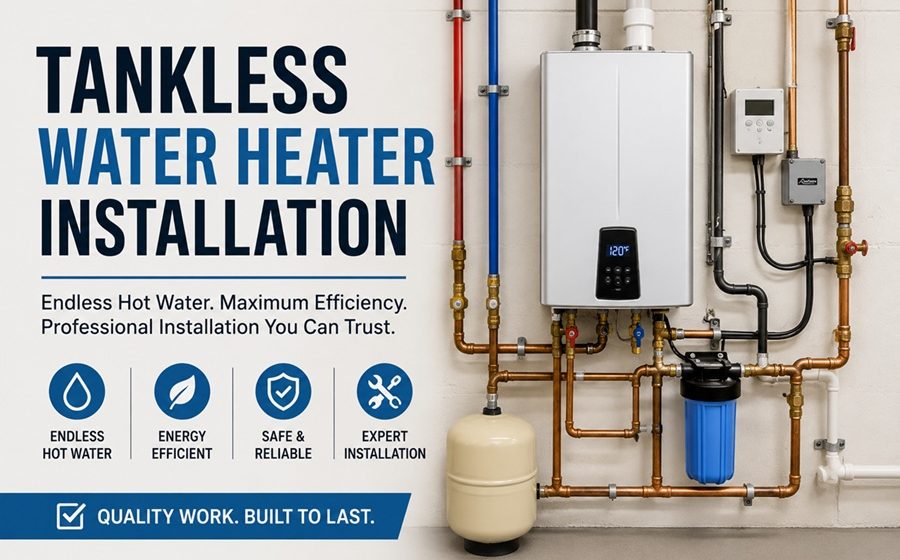

Tankless water heater installation is the process of fitting an on-demand unit that heats water only as you use it, instead of storing and constantly reheating a tank of hot water. Because it heats water on the fly, a tankless unit delivers essentially endless hot water, takes up far less space, and is more energy-efficient than a traditional tank, though it costs more upfront and the installation is more involved, often requiring upgraded gas lines, electrical, or venting. For many homeowners, the long-term savings and endless hot water make it a worthwhile upgrade.
Switching to tankless is a bigger project than swapping one tank for another, which is why professional installation is strongly recommended. Understanding how these units work, their genuine pros and cons, what the installation involves, and what drives the cost helps you decide whether tankless is right for your home. This guide covers all of it clearly.
| What it is | An on-demand heater that heats water as you use it |
| Key benefit | Endless hot water and energy savings |
| Space | Compact, wall-mounted, frees up floor space |
| Efficiency | More efficient than constant tank reheating |
| Upfront cost | Higher than a traditional tank |
| Install complexity | Often needs gas, electrical, or venting upgrades |
| Lifespan | Commonly 20+ years, longer than a tank |
| Best installed by | A licensed professional |
How a Tankless Heater Works
A traditional water heater keeps a large tank of water hot around the clock, reheating it whenever it cools, which wastes energy on standby losses. A tankless unit works completely differently: when you turn on a hot tap, cold water flows through the unit and a powerful gas burner or electric element heats it instantly, on demand. When you turn the tap off, the heating stops.
Because it only heats water when you need it, there is no tank of water losing heat and no running out mid-shower, which is where the promise of endless hot water comes from. The unit is compact enough to mount on a wall, reclaiming the floor space a bulky tank once occupied.
The Benefits
- Endless hot water, since it heats continuously on demand
- Lower energy bills by eliminating standby heat loss
- A compact, wall-mounted design that saves space
- A longer lifespan, often 20 years or more
- Only heating water when needed, which suits efficiency-minded homes
The Drawbacks
- A higher upfront cost for the unit and installation
- More complex installation, often needing gas, electrical, or venting upgrades
- Limited simultaneous flow, so heavy demand may need a larger or additional unit
- A slight delay before hot water reaches the tap
- Potential for mineral scaling in hard water without maintenance
What the Installation Involves
Installing a tankless unit is more than a simple swap because the technology has different requirements than a tank. The specifics depend on whether you choose gas or electric and on your home’s existing infrastructure.
- A professional assesses your hot water demand and your home’s gas, electrical, and venting.
- The old tank is drained, disconnected, and removed.
- Gas line, electrical capacity, or venting is upgraded if the new unit requires it.
- The tankless unit is mounted, typically on a wall, and connected to water and fuel.
- Proper venting is installed for a gas unit, and the system is tested and checked.
- The installer confirms performance and explains operation and maintenance.
Why Professional Installation Matters
This is not a DIY project for most people, because a tankless unit often demands a larger gas line to feed its powerful burner, dedicated electrical capacity, and specific venting, all of which carry safety and code requirements. An undersized gas line or improper venting can leave the unit underperforming or unsafe. A qualified installer sizes the unit to your household’s peak demand, handles the infrastructure upgrades correctly, and ensures the installation meets code, which protects both performance and safety.
What It Costs
Tankless installation costs more than a standard tank, and the total depends heavily on your home’s existing setup. The unit itself is pricier, and the infrastructure upgrades are the biggest variable.
| Cost Factor | Effect | Notes |
| The unit | Higher than a tank | Gas units often cost more than electric |
| Gas line upgrade | Can add significantly | Needed for many gas units |
| Electrical upgrade | Adds cost | For electric units drawing high power |
| Venting | Adds cost for gas | Specific venting required |
| Labour | Varies with complexity | More involved than a tank swap |
While the upfront cost is higher, the energy savings and long lifespan help offset it over time, and the endless hot water and reclaimed space are benefits a tank cannot match.
Maintenance for Long Life
Tankless units last a long time, often outliving two tank heaters, but they benefit from occasional care, especially in hard-water areas. Mineral scale can build up inside the unit and reduce efficiency, so periodic descaling or flushing, typically once a year, keeps it running well. Many units have a filter to clean too. Following the manufacturer’s maintenance guidance protects your investment and helps the heater reach its full two-decade-plus lifespan.
Frequently Asked Questions
Is a tankless water heater worth it?
For many homeowners, yes. You get endless hot water, lower energy bills, a compact design, and a longer lifespan. The trade-off is a higher upfront cost, so it is most worthwhile if you plan to stay in the home long enough to enjoy the savings.
Can I install a tankless water heater myself?
It is strongly recommended to use a professional. Installation often requires upgrading gas lines, electrical, or venting, all with safety and code implications, so a licensed installer is the safe and proper choice.
Do tankless heaters really provide endless hot water?
Yes, because they heat water continuously on demand rather than from a finite tank. The limit is flow rate, so very heavy simultaneous use may require a larger unit or a second one to keep up.
How long do tankless water heaters last?
They commonly last 20 years or more, notably longer than a typical tank heater. Regular descaling, especially in hard-water areas, helps them reach their full lifespan efficiently.
How many tankless units does a home need?
It depends on peak simultaneous demand. A single well-sized unit serves many homes, but very high demand, several showers and appliances at once, may call for a larger unit or a second one to keep up.
Do tankless heaters work in cold climates?
Yes, though incoming water is colder in winter, which lowers the flow rate a unit can heat to temperature. Sizing the unit for winter conditions ensures it keeps up with demand year-round.
Do tankless water heaters need maintenance?
Yes. Periodic descaling or flushing, typically once a year, clears mineral scale that reduces efficiency, and any inlet filter should be cleaned. This simple upkeep helps the unit reach its full two-decade-plus lifespan running efficiently.
Gas vs Electric Tankless Units
When choosing a tankless heater, one of the biggest decisions is gas versus electric, and it shapes both performance and the installation. Gas tankless units, powered by natural gas or propane, generally deliver higher flow rates, making them well suited to larger households that run multiple hot-water fixtures at once. However, they require proper venting and often a larger gas line, which adds to installation complexity and cost.
Electric tankless units are typically simpler to install since they need no venting, and they can be a great fit for smaller homes, apartments, or point-of-use applications like a single bathroom. Their limitation is that heating water electrically on demand draws a lot of power, so a whole-home electric unit may require significant electrical capacity, sometimes a panel upgrade, to run properly.
The right choice depends on your home’s existing utilities, your hot-water demand, and local energy costs. A household with an established gas line and high simultaneous demand often leans gas, while a smaller home or one without gas service may find electric more practical. A qualified installer can size the demand and advise which type best fits your situation and budget.
- Gas units offer higher flow for larger households
- Gas requires venting and often a bigger gas line
- Electric units skip venting and suit smaller homes
- Whole-home electric may need added electrical capacity
- Choose based on utilities, demand, and energy costs
Final Thoughts
A tankless water heater is a compelling upgrade that trades a higher upfront cost for endless hot water, lower energy bills, a smaller footprint, and a longer lifespan. The catch is that installation is more involved, frequently requiring gas, electrical, or venting upgrades, which makes professional installation essential for safety and performance. Size the unit to your household’s demand, keep up with descaling in hard water, and a tankless heater can deliver efficient, on-demand hot water for two decades or more.