
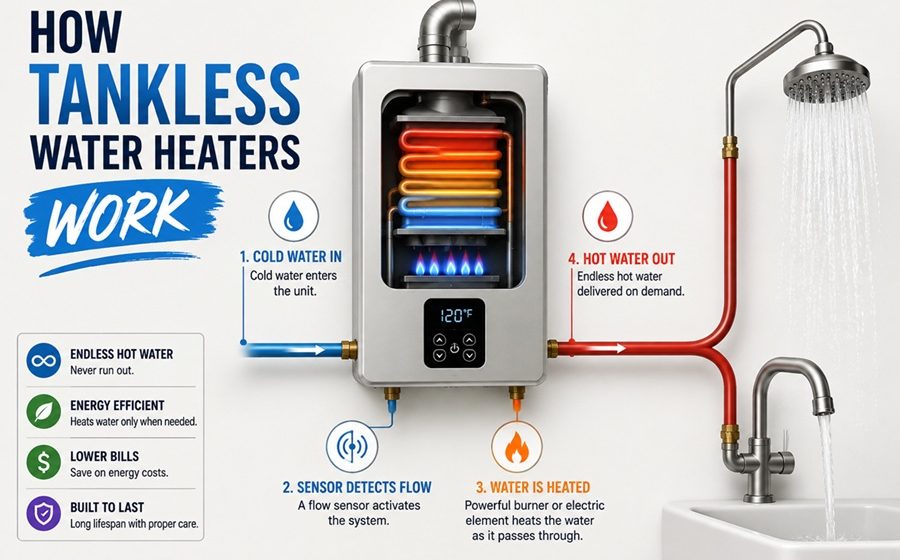

A tankless water heater works by heating water instantly as it flows through the unit, rather than storing hot water in a tank. When you turn on a hot tap, a flow sensor detects the water moving and activates a powerful gas burner or electric heating element, which rapidly heats the water as it passes through a heat exchanger and travels straight to your faucet. Because it heats on demand and only while water is flowing, a tankless unit delivers a continuous supply of hot water and wastes no energy keeping a tank hot when you are not using it.
This on-demand approach is fundamentally different from the familiar tank water heater, and understanding the mechanism explains the benefits people associate with tankless, endless hot water, energy savings, and a compact size. This guide breaks down exactly how a tankless heater heats water, the role each part plays, the difference between gas and electric models, and why these units never run out of hot water the way a tank can.
| Core principle | Heats water on demand as it flows, no storage |
| Trigger | A flow sensor detecting water movement |
| Heat source | A gas burner or electric heating element |
| Key part | The heat exchanger that transfers heat to the water |
| Result | A continuous supply of hot water |
| Energy saving | No standby loss from a stored tank |
| Limit | Flow rate, not a finite tank of water |
| Size | Compact and wall-mounted |
The Basic Idea: Heating on Demand
A traditional water heater keeps a large tank of water hot all day, reheating it whenever it cools, so hot water is always waiting but energy is constantly spent maintaining it. A tankless heater flips this model. It stores no water and stays idle until you actually call for hot water, at which point it springs into action and heats the water on the spot. When you turn the tap off, it stops.
This is why tankless units are also called on-demand or instantaneous water heaters. The whole design is built around heating water only in the moment you need it, which is the source of both their efficiency and their ability to supply hot water continuously.
Step by Step: What Happens When You Turn On the Tap
The sequence inside a tankless heater happens in seconds. Following it makes the whole concept clear.
- You open a hot water tap, and cold water begins flowing into the unit.
- A flow sensor detects the moving water and signals the heater to activate.
- The gas burner ignites or the electric element energizes.
- Water flows through the heat exchanger, which rapidly transfers heat into it.
- Hot water exits the unit and travels to your tap in a continuous stream.
- When you close the tap, the sensor stops the heater until next time.
The Heart of It: The Heat Exchanger
The heat exchanger is the key component that makes instant heating possible. It is a system of coils or plates designed to transfer heat from the burner or element into the water as quickly as possible while the water passes through. Because the water moves through the exchanger continuously, it comes out hot without any need for storage. The power of the burner or element and the efficiency of the heat exchanger determine how quickly and how much water the unit can heat, which sets its flow rate.
Gas vs Electric Tankless Heaters
Tankless heaters come in gas and electric versions, and while both heat on demand, they do so with different energy sources. The choice affects flow rate and installation.
| Type | How It Heats | Notes |
| Gas tankless | A gas burner heats the exchanger | Higher flow, needs venting and gas line |
| Electric tankless | Electric elements heat the water | Simpler install, needs ample electrical capacity |
| Both | Heat water on demand as it flows | No tank, continuous hot water |
Why They Never Run Out of Hot Water
The famous promise of endless hot water comes directly from the on-demand design. A tank heater holds a finite amount of hot water, so a long shower or several fixtures at once can drain it, leaving you cold until it reheats. A tankless heater has no tank to empty; as long as water flows, it keeps heating, so it never runs out in that way. The one real limit is flow rate, the amount of hot water it can produce per minute. If demand exceeds that rate, such as many fixtures running at once, the temperature can drop, which is why units are sized to a household’s peak demand.
Why This Design Saves Energy
Heating on demand also explains the efficiency advantage. A tank heater loses energy continuously through standby heat loss, reheating stored water around the clock even when no one is home. A tankless heater eliminates that waste entirely by only using energy when hot water is actually being drawn. Over time, avoiding those constant standby losses is what gives tankless units their lower energy consumption compared with a traditional tank.
Frequently Asked Questions
How does a tankless water heater heat water so fast?
It uses a powerful gas burner or electric element and a heat exchanger that rapidly transfers heat into the water as it flows through. Because the heating happens continuously while water moves, it delivers hot water almost immediately on demand.
Do tankless water heaters use a lot of energy at once?
They use significant power while running, since heating water instantly takes a lot of energy in that moment, which is why gas units need a good gas line and electric units need ample electrical capacity. But they use no energy when idle, saving overall.
Why does my tankless water not run out?
Because there is no tank to empty. The unit heats water continuously as it flows, so hot water keeps coming as long as the tap is open. The only limit is flow rate, the volume it can heat per minute.
Is a flow sensor really what turns it on?
Yes. When you open a hot tap, a flow sensor detects the moving water and signals the unit to fire the burner or energize the elements. Closing the tap stops the flow, and the heater shuts off until next time.
Is a tankless water heater better than a tank?
It depends on your needs. Tankless offers endless hot water, efficiency, a compact size, and a longer lifespan, while tanks are cheaper upfront and simpler to install. The right choice hinges on budget, usage, and how long you will stay.
How It Differs From a Tank Heater
Seeing how a tankless heater differs from the tank most people grew up with makes its workings even clearer. A tank heater is essentially a big insulated container of water kept hot at all times, ready to draw but constantly losing and replacing heat. A tankless heater has no such reservoir; it is a compact unit that heats water only in the instant you need it, which is a completely different approach to the same goal.
This design difference explains the practical contrasts. The tank’s stored hot water can run out during heavy use and then needs time to reheat, while the tankless unit keeps producing hot water as long as the tap runs. The tank wastes energy on standby heat loss around the clock, while the tankless uses energy only on demand. And the bulky tank takes up floor space, while the tankless mounts compactly on a wall.
Understanding these contrasts helps set expectations. A tankless heater is not simply a smaller tank; it is a fundamentally different machine that trades constant readiness for on-demand heating. That trade is what delivers endless hot water and efficiency, and it is why the flow rate, how much it can heat per minute, matters more than any tank capacity ever did.
- A tank stores hot water; tankless heats on demand
- Tanks can run out and need reheating; tankless does not
- Tanks lose energy to standby heat; tankless does not
- Tanks are bulky; tankless mounts compactly on a wall
- Flow rate replaces tank size as the key measure
Final Thoughts
A tankless water heater works by heating water instantly as it flows, activated by a flow sensor and powered by a gas burner or electric element that transfers heat through a heat exchanger. Because it heats only on demand and stores nothing, it delivers a continuous supply of hot water and avoids the standby energy waste of a tank. The single limit is flow rate, so units are sized to household demand. Understanding this simple on-demand principle explains everything people love about tankless: endless hot water, efficiency, and a compact design.

