
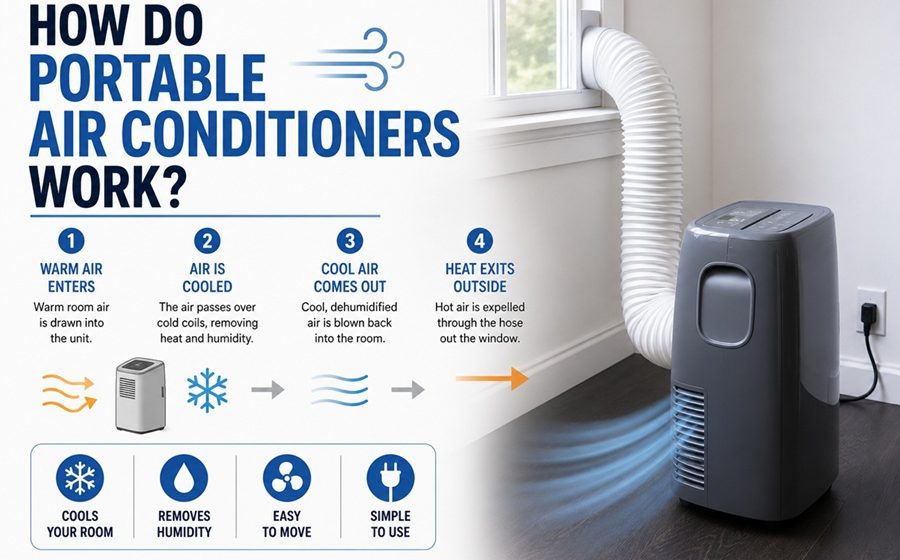

A portable air conditioner works by drawing in warm room air, cooling it using the same refrigeration cycle as any air conditioner, and blowing the cooled air back into the room while venting the resulting hot air outside through an exhaust hose that runs to a window. In simple terms, it is a self-contained cooling unit on wheels that pulls heat out of your room’s air and pushes that heat outdoors through the hose. The refrigerant absorbs heat from the air inside and releases it outside, and any moisture removed from the air is collected or evaporated away.
Portable air conditioners appeal to people who cannot install a window unit or want cooling they can move from room to room, so understanding how they work helps you use one effectively and set it up correctly. The exhaust hose is central to the whole thing, since venting the hot air outside is what makes real cooling possible. This guide explains the cooling cycle, the role of the hose, the difference between single and dual-hose designs, how they handle moisture, and their pros and cons.
| Core process | Refrigeration cycle, like any air conditioner |
| Key feature | A self-contained unit on wheels |
| Essential part | An exhaust hose venting hot air out a window |
| How it cools | Refrigerant absorbs indoor heat, releases it outdoors |
| Moisture | Collected in a tank or evaporated out the hose |
| Designs | Single-hose and dual-hose |
| Best for | Rooms where window units are impractical |
| Bonus | Movable from room to room |
The Cooling Cycle in Simple Terms
At its heart, a portable air conditioner uses the same refrigeration cycle as a window unit or central system. It contains a refrigerant that circulates through the unit, absorbing heat from the warm room air blown across cold coils, then carrying that heat away to be released. A compressor and coils drive the process, and a fan pushes the now-cooled air back into the room. The magic is simply moving heat from one place, your room, to another, the outdoors.
This is an important distinction: an air conditioner does not create cold so much as remove heat. The warm air in your room gives up its heat to the refrigerant, and that heat has to go somewhere, which is where the exhaust hose becomes essential.
Why the Exhaust Hose Matters
The exhaust hose is what separates a real portable air conditioner from a device that just blows air around. As the unit removes heat from your room’s air, that heat must be expelled outside, and the hose carries it out through a window using an included window kit. Without venting the hot air outdoors, the heat would simply return to the room and no real cooling would occur.
This is why a genuine portable AC always has a hose to a window, and why proper setup matters. If the hose is disconnected or the window seal is poor, hot air leaks back in and cooling suffers. Getting the hose routed to the window and the window kit sealed well is the single most important step in setting one up.
Single-Hose vs Dual-Hose Designs
Portable air conditioners come in two main configurations, and the difference affects efficiency. Knowing which you have, or are buying, helps you understand its performance.
| Design | How It Works | Trade-off |
| Single-hose | Uses room air to cool the unit, vents it out | Simpler, but creates slight negative pressure |
| Dual-hose | One hose draws outside air in, one exhausts | More efficient, especially in larger rooms |
Single-hose units are the most common and work well for many rooms, though by expelling room air they create slight negative pressure that can pull warm air in from elsewhere. Dual-hose units use one hose to bring in outside air for cooling the components and another to exhaust, which tends to be more efficient, particularly in larger spaces.
How They Handle Moisture
Cooling air also removes humidity from it, so portable air conditioners have to deal with the water they extract. Different units handle this in different ways. Some collect the condensate in an internal tank that you periodically empty. Many modern units are self-evaporating, meaning they expel most of the moisture out through the exhaust hose along with the hot air, so you rarely or never empty a tank. Some also offer a drain hose option for continuous drainage. Understanding your unit’s method helps you avoid the surprise of a full tank shutting the unit off.
Pros and Cons of Portable Units
| Pros | Cons |
| No permanent window installation | Less efficient than window or central AC |
| Movable from room to room | The exhaust hose must reach a window |
| Good where window units will not fit | Takes up floor space |
| Simple setup with a window kit | Can be noisier, being inside the room |
| Often adds dehumidifying and fan modes | May need occasional tank emptying |
Getting the Best Performance
To cool effectively, a portable AC needs good setup and the right size. Seal the window kit well so hot air does not leak back in, keep the exhaust hose as short and straight as practical, and match the unit’s BTU rating to your room size so it can keep up. Closing doors to the room being cooled concentrates the effect, and keeping the filter clean maintains airflow. With those basics right, a portable unit delivers genuine cooling where a window or central system is not an option.
Frequently Asked Questions
Do portable air conditioners really cool a room?
Yes, when set up correctly. They use the same refrigeration cycle as other air conditioners and vent hot air outside through an exhaust hose. Proper venting and a good window seal are essential, since without them the heat returns and cooling suffers.
Why do portable ACs need a hose to a window?
Because cooling removes heat from the room, and that heat must go somewhere. The exhaust hose carries the hot air outside through a window. Without it, the heat would return to the room, so no real cooling would happen.
Is a dual-hose portable AC better than single-hose?
Dual-hose units are generally more efficient, especially in larger rooms, because they use outside air to cool the components rather than expelling conditioned room air. Single-hose units are simpler and common, and work well for many spaces.
Do I have to empty water from a portable AC?
It depends on the unit. Some collect condensate in a tank you empty periodically, while many modern units are self-evaporating and expel most moisture out the exhaust hose, rarely needing emptying. Some also offer a continuous drain option.
Portable vs Window Air Conditioners
Because portable and window air conditioners are often considered together, it helps to understand how they compare. Both use the same refrigeration cycle to cool a room, but they are installed and used differently, and each suits different situations. A window unit mounts in a window and generally cools more efficiently for its size, while a portable unit sits on the floor and vents through a hose, trading some efficiency for flexibility.
The portable unit’s big advantages are that it needs no permanent window installation and can be wheeled from room to room, which is ideal for renters, windows that cannot take a unit, or anyone wanting movable cooling. The trade-offs are that portable units tend to be less efficient than window units, take up floor space, and can be a bit noisier since the whole unit sits inside the room.
Choosing between them comes down to your situation. If you have a suitable window and want the most efficient cooling for the price, a window unit is often the better value. If you cannot or prefer not to install a window unit, or you want the flexibility to move cooling around, a portable unit earns its place despite the efficiency trade-off. Both, set up correctly, deliver real cooling.
- Both use the same refrigeration cycle to cool
- Window units are generally more efficient for their size
- Portable units need no permanent install and are movable
- Portable units use floor space and can be a bit noisier
- Choose based on your windows, efficiency needs, and flexibility
Final Thoughts
A portable air conditioner works by using the standard refrigeration cycle to pull heat from your room’s air and venting that heat outside through an exhaust hose to a window, blowing cooled air back into the room. The hose is essential, since expelling the hot air is what makes real cooling possible, and single versus dual-hose designs affect efficiency. Match the unit to your room, seal the window kit well, and handle the moisture per your model, and a portable AC delivers flexible, effective cooling wherever a window or central system is not practical.