
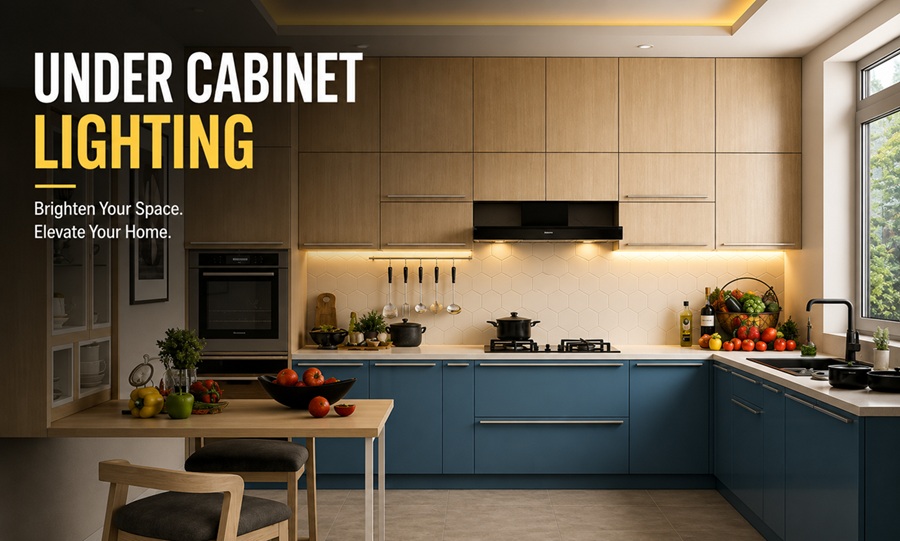

Under cabinet lighting is task and accent lighting mounted beneath your upper cabinets to brighten the countertops below. The best options for most kitchens are LED strip lights, which give smooth, even coverage across the whole counter, or LED puck lights, which cast focused pools of light. You can power them by hardwiring into your electrical, plugging into an outlet, or using battery and rechargeable units, so there is a version for every skill level and budget.
It is one of the highest-impact, lowest-cost upgrades in a kitchen, erasing the shadows that upper cabinets cast over your workspace and adding a warm glow in the evening. This guide walks through the lighting types, the power options, how to pick color temperature and brightness, and what installation actually involves, so you can choose the right setup with confidence.
| What it is | Lighting mounted under upper cabinets |
| Best all-round type | LED strip or tape light |
| Focused option | LED puck lights |
| Power options | Hardwired, plug-in, or battery/rechargeable |
| Best color temperature | Around 2700K to 3500K for kitchens |
| Main benefit | Removes counter shadows; adds ambiance |
| DIY difficulty | Easy (plug-in/battery) to moderate (hardwired) |
| Lifespan | LEDs last many years |
Why Add Under Cabinet Lighting
Overhead kitchen lights sit behind you when you stand at the counter, so your upper cabinets throw shadows exactly where you chop, read recipes, and work. Under cabinet lighting solves that by placing light right at the source, illuminating the countertop evenly and making the whole space safer and more pleasant to use.
Beyond the practical task lighting, it doubles as ambiance. Left on at a low level in the evening, it gives the kitchen a soft, inviting glow without the glare of overhead fixtures. That mix of function and mood is why it is one of the most recommended kitchen upgrades.
The Main Types
The format you choose shapes how the light looks on your counters. The two most popular are strips and pucks, with a couple of variations worth knowing.
| Type | Light Pattern | Best For |
| LED strip / tape | Even, continuous line | Smooth, shadow-free counters |
| LED puck lights | Focused pools | Accents and specific spots |
| Linear light bars | Even, rigid strips | Easy DIY even coverage |
| Rope / flexible LED | Soft, diffuse glow | Ambiance over task light |
Power Options Explained
How the lights get their power is the biggest factor in installation difficulty and where you can place them. Each approach suits a different situation.
| Power Type | Install Difficulty | Best For |
| Hardwired | Moderate to advanced | A clean, permanent, switch-controlled setup |
| Plug-in | Easy | Near an existing outlet, no wiring |
| Battery | Very easy | Renters and quick fixes |
| Rechargeable | Very easy | No wiring, periodic recharging |
Hardwired lighting gives the most seamless, wire-free result and can tie into a wall switch, but it usually means running low-voltage wiring and, for many people, hiring an electrician. Plug-in strips are the popular middle ground, offering a clean look with the simplicity of an outlet. Battery and rechargeable units ask nothing of your wiring at all, which makes them ideal for renters, though they need periodic recharging or battery changes.
Choosing Color Temperature
Color temperature sets the mood and affects how food and surfaces look. Measured in Kelvin, lower numbers are warm and cozy while higher numbers are crisp and bright. Kitchens generally look best in the warm-to-neutral range.
| Kelvin | Light Color | Effect in a Kitchen |
| 2700K | Warm white | Cozy, inviting glow |
| 3000K | Soft white | Balanced and flattering |
| 3500K | Neutral white | Clean and functional |
| 4000K+ | Cool white | Very bright, more clinical |
How Bright Should It Be?
Brightness for LEDs is measured in lumens. For task lighting over a work surface you want a solid, usable level, but under cabinet lighting rarely needs to be blinding since it supplements your main lights. Look for strips or pucks rated for enough lumens per foot to light the counter clearly, and consider a dimmable option so you can turn it down for evening ambiance and up for detailed prep work.
How to Choose the Right Setup
- Measure the underside length of your cabinets to size strips correctly
- Pick strips for even coverage or pucks for focused accent light
- Match the power option to your DIY comfort and outlet access
- Choose a warm-to-neutral color temperature for a welcoming kitchen
- Favor dimmable, and look for even diffusion to avoid visible dots
- Mount toward the front edge of the cabinet to light the counter, not the wall
Installation Basics
For plug-in and battery options, installation is largely a matter of cleaning the mounting surface, sticking or clipping the lights toward the front underside of the cabinet, and connecting the power. Hardwired setups add steps: running low-voltage wiring, connecting a driver or transformer, and tying into a switch, which is where many homeowners bring in an electrician. Whatever the type, positioning the lights near the front of the cabinet underside is the trick to lighting the countertop evenly rather than washing the backsplash.
What It Costs
Under cabinet lighting spans a wide price range depending on type and whether you hire help. Battery pucks and basic plug-in strips are inexpensive and DIY-friendly, making this an accessible weekend project. Higher-end hardwired systems with dimming and premium diffusers cost more, and professional installation adds labour. Because LEDs last for years and sip electricity, the running cost afterward is minimal.
Common Mistakes to Avoid
- Mounting strips at the back, which lights the wall instead of the counter
- Choosing a harsh, cool color that makes the kitchen feel clinical
- Buying low-density strips that show individual dots of light
- Ignoring dimmability and ending up stuck at one brightness
- Underestimating the wiring involved in a hardwired install
Frequently Asked Questions
Are LED strips or puck lights better?
Strips give smooth, even coverage across the whole counter, which most people prefer for task lighting. Puck lights create focused pools and suit accenting specific spots. Many kitchens look best with strips, but it comes down to the effect you want.
Do I need an electrician?
Not for plug-in or battery options, which anyone can install. Hardwired systems that tie into a switch usually benefit from an electrician unless you are comfortable running low-voltage wiring safely.
What color temperature is best for a kitchen?
Around 2700K to 3500K works well, giving a warm-to-neutral light that is inviting yet functional. Cooler temperatures above 4000K are very bright but can feel clinical in a home kitchen.
Can renters install under cabinet lighting?
Yes, battery and rechargeable stick-on lights are ideal for renters since they need no wiring and leave no permanent changes. Plug-in strips work too wherever an outlet is within reach.
Beyond the Kitchen Counter
Although kitchens are the classic spot, the same under cabinet lighting techniques brighten and elevate plenty of other places in the home. Anywhere you have a shelf, cabinet, or overhang casting a shadow is a candidate, and the low cost of LED strips makes it easy to experiment.
In a home office, a strip under a hutch or floating shelf lights the desk without a bulky lamp. In a bathroom, lighting beneath a vanity or floating cabinet adds a soft glow that doubles as a gentle night light. Display cabinets and bookshelves come alive when lit from within or beneath, drawing the eye to what is on them, and a strip run under a bar or island overhang adds warmth to an entertaining space.
The principles stay the same wherever you use it: position the light toward the front edge to illuminate the surface rather than the wall, choose a warm-to-neutral color for a homey feel, and favour dimmable options so the light suits both task and mood. Once you see how much a hidden strip transforms one spot, it is tempting to add a little glow throughout the house.
One practical tip when spreading lighting across rooms is to keep the color temperature consistent from space to space. Mixing a warm strip in the kitchen with a cool one in the office can make the whole home feel slightly disjointed when you glance from room to room. Picking a single color temperature you like and sticking with it gives the house a cohesive, intentional feel, and it also means any spare strips or drivers you buy will always match what you already have installed.
Final Thoughts
Under cabinet lighting delivers a lot of everyday value for modest effort: brighter, shadow-free counters when you work and a soft glow when you relax. Decide between smooth strips and focused pucks, match the power option to your DIY comfort, choose a warm-to-neutral color, and mount toward the front of the cabinet for even light. Whether you go battery-simple or hardwired-permanent, it is one of the easiest ways to make a kitchen both more usable and more inviting.