
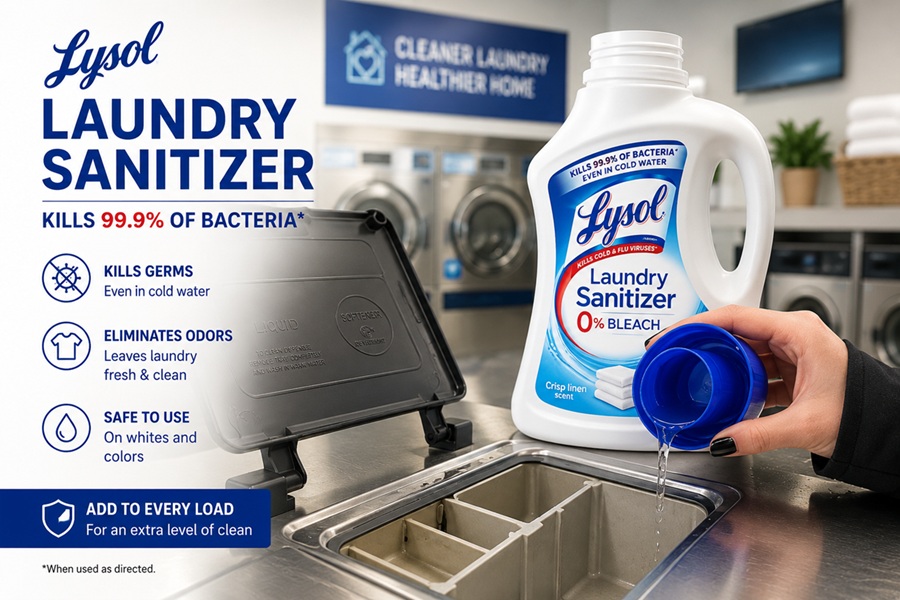

Lysol Laundry Sanitizer is a liquid laundry additive that kills 99.9% of the bacteria your regular detergent leaves behind, and it does so without any bleach and even in cold water. You add it to the rinse cycle rather than the wash, let it sit for about 16 minutes, and it targets the odor-causing bacteria that can survive an ordinary wash and leave towels, gym clothes, and bedding smelling stale.
Unlike a scent booster that simply masks smells with fragrance, this product actually removes the bacteria causing them. It is registered with the EPA and is gentle enough for delicates, baby clothes, and colors, which is a big part of its appeal for households that cannot use hot water or bleach on everything. Here is a full, practical look at what it does and exactly how to use it.
| Product type | Liquid laundry sanitizing additive |
| Kills | 99.9% of odor-causing bacteria detergent leaves behind |
| Bleach content | 0% – a color-safe bleach alternative |
| Works in | Cold water, standard and HE machines |
| Where it goes | The rinse cycle, not the main wash |
| Dwell time | About 16 minutes in the rinse |
| Scents | Crisp Linen, Lavender Fusion, Tropical Escape, Sport, Free & Clear |
| Sizes | Commonly 21 oz, 41 oz, and 90 oz |
| Good for | Towels, bedding, gym clothes, baby items, delicates |
Why Detergent Alone Is Not Always Enough
Modern laundry habits work against full sanitizing. To save energy and protect fabrics, most of us wash in cold water, but cold water and regular detergent do not kill all the bacteria on clothes. That is why a load can look and smell clean coming out of the machine yet still harbour the microbes that cause that musty, never-quite-fresh odor, especially in synthetic activewear where smells cling stubbornly.
Bleach and very hot water can kill those bacteria, but both are harsh, fade colors, and are off-limits for delicates and many fabrics. A dedicated sanitizer fills that gap, letting you sanitize a mixed load gently without reaching for bleach or cranking up the heat.
How to Use It, Step by Step
The process is simple, but the details matter, since this product belongs in the rinse cycle rather than mixed in with your detergent at the start. Follow these steps for the sanitizing effect to actually work.
- Wash your laundry as normal with your usual detergent.
- Measure two capfuls of Lysol Laundry Sanitizer using the dosing cup.
- Add it to the fabric softener compartment, or pour it directly into the drum during the rinse cycle if your machine has no softener dispenser.
- Let the product remain in the rinse for about 16 minutes so it can work.
- Finish the cycle and dry your laundry as usual.
Dosing differs slightly by machine. For standard machines you fill two capfuls to the first line of the cup, while high-efficiency machines use two capfuls filled to the second line. Getting the dose right keeps it effective without waste.
Scents and Sizes at a Glance
| Option | Choices | Best For |
| Scented | Crisp Linen, Lavender Fusion, Tropical Escape, Sport | Everyday freshness |
| Unscented | Free & Clear (no fragrance or dyes) | Baby items and sensitive skin |
| Sizes | 21 oz, 41 oz, 90 oz | Occasional use up to large households |
What It Is Great For
Because it is gentle and bleach-free, it suits many items that cannot handle harsher sanitizing. It is especially useful for anything that traps odors or is used by someone whose laundry you want extra clean.
- Towels and bedding that pick up a damp, musty smell
- Gym clothes and synthetic activewear that hold odor
- Baby clothes, blankets, and burp cloths
- Undergarments and delicates that skip hot washes
- Laundry during cold and flu season when someone is unwell
Sanitizer vs Detergent vs Scent Booster
It helps to see where a sanitizer fits, because it does a different job from the other two products and is not a replacement for detergent.
| Product | Main Job | Kills Bacteria? |
| Detergent | Lifts dirt and stains | Not fully in cold water |
| Scent booster | Adds lasting fragrance | No, it masks odor |
| Laundry sanitizer | Removes odor-causing bacteria | Yes, 99.9% as directed |
A Few Practical Cautions
As with any cleaning product, a little care keeps things safe and effective. Always follow the label directions, since dosing and timing are what make the sanitizing claim hold true. Keep the bottle out of reach of children and pets, and do not pour it directly onto fabric in a concentrated stream, as it belongs diluted in the rinse water. If you have very sensitive skin or allergies, the Free & Clear version avoids added fragrance and dyes.
Getting the Most From Every Load
A sanitizer only works as well as the wash around it, so a few habits make a real difference. The most common mistake is overloading the machine. When clothes are packed too tightly, water and product cannot circulate freely, and the sanitizer struggles to reach every surface. Leaving a little room in the drum lets the rinse do its job properly.
Timing is the other thing people get wrong. Because the product goes into the rinse rather than the initial wash, adding it too early means it drains away with the wash water before it can act. If your machine lacks a fabric softener dispenser, wait for the rinse cycle to begin before pouring it into the drum, and give it the full dwell time rather than cutting the cycle short.
Pairing the sanitizer with good drying habits locks in the benefit. Bacteria and odors thrive in damp fabric, so move laundry to the dryer or line promptly rather than leaving a finished load sitting wet in the machine. For heavily used items like gym towels, this combination of sanitizing and prompt drying is what finally breaks the cycle of that reappearing musty smell.
- Do not overfill the drum, so product can circulate
- Add it during the rinse, never with the initial wash
- Use the full dwell time rather than a shortened cycle
- Dry laundry promptly to stop odors returning
- Choose Free & Clear for the most sensitive skin
Frequently Asked Questions
Does Lysol Laundry Sanitizer replace detergent?
No. It is an additive used alongside your normal detergent, not instead of it. Detergent cleans away dirt and stains, while the sanitizer targets the bacteria left behind in the rinse.
Can I use it in cold water?
Yes, that is one of its main advantages. It is formulated to work in cold water, so you can sanitize without switching to a hot wash that might fade or shrink fabrics.
Is it safe for colors and delicates?
It is a bleach-free, color-safe formula gentle on most fabrics, including whites, colors, and delicates. For fragrance-sensitive items like baby clothes, the Free & Clear version skips dyes and scent.
Will it get rid of set-in odors?
Because it kills the bacteria that cause odors rather than masking them, it is effective on the stubborn musty and sweat smells that regular washing leaves behind, particularly in synthetic fabrics.
Building It Into Your Routine
The easiest way to get lasting value from a sanitizer is to reserve it for the loads that truly benefit rather than using it on everything. Everyday lightly worn clothes rarely need it, but there are specific loads where it earns its place every time, and targeting those keeps a bottle lasting far longer.
Think of it as a tool for problem laundry: the gym bag pile, the bath towels that never smell quite fresh, the bedding after someone has been unwell. Used consistently on those, it breaks the cycle of lingering odor that fabric softener only temporarily hides. Over a few weeks you will notice those items staying fresher between washes, which is the real payoff.
- Reserve it for odor-prone and high-use items to stretch the bottle
- Run it on towels and bedding on a regular rotation
- Use it after illness to sanitize a sick person’s laundry
- Add it to sweaty activewear loads every time
- Keep an unscented bottle on hand for baby and sensitive items
- Store it upright, sealed, and away from children
Final Thoughts
Lysol Laundry Sanitizer earns its place for anyone who washes cold, deals with odor-prone activewear, or simply wants an extra layer of clean without bleach. Use it in the rinse cycle, give it the full 16 minutes, and match the dose to your machine type. It will not clean stains, so keep using your detergent, but as a gentle, color-safe way to knock out the bacteria that make laundry smell stale, it is a genuinely useful addition to the routine.