
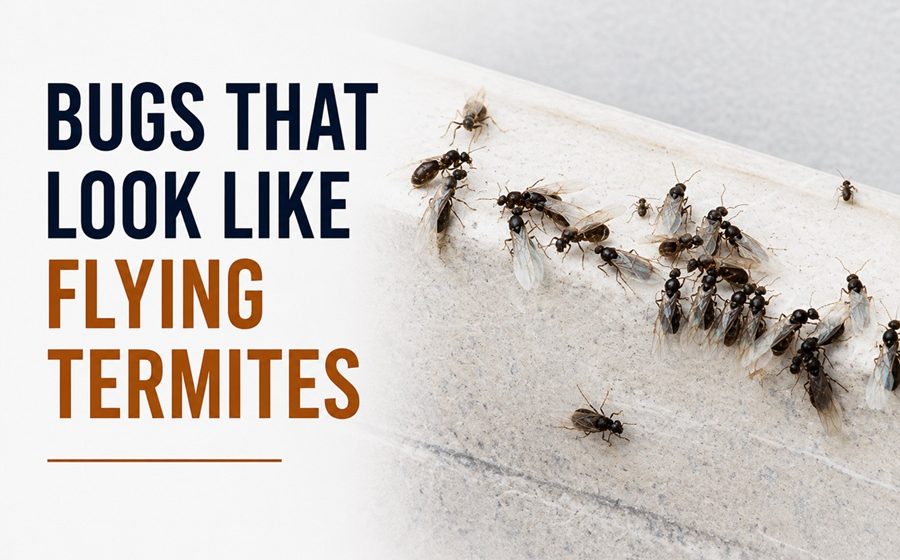

The bug most often mistaken for a flying termite is the flying ant, and the two are so similar at a glance that they fool many homeowners every spring. You can tell a flying termite from its look-alikes by three features: flying termites have a straight, thick body with no pinched waist, straight antennae, and two pairs of wings that are equal in length, while flying ants and other winged look-alikes have a pinched waist, bent antennae, or unequal wings. Since a flying termite signals a nearby colony and potential structural damage, correctly identifying these winged swarmers is genuinely important.
When winged insects suddenly appear around your windows or lights, especially in spring, it is natural to worry about termites. But several flying bugs resemble termite swarmers, and most are harmless. This guide focuses specifically on the winged look-alikes, explains how to distinguish a true flying termite from each, and shows you the clues that reveal whether you have a termite problem or a harmless swarm.
| Top look-alike | Flying (winged) ants |
| Other winged confusions | Other swarming ants and small flying insects |
| Flying termite waist | Thick, straight, no pinch |
| Flying termite antennae | Straight and bead-like |
| Flying termite wings | Two pairs, equal length, longer than body |
| Flying ant wings | Front pair longer than rear pair |
| Why it matters | A flying termite signals a colony nearby |
| Swarming season | Most common in spring |
Why Flying Swarmers Cause Confusion
Both termites and ants reproduce by sending out winged adults, called swarmers or alates, that fly off to start new colonies. Because these swarms happen at similar times, often on warm, humid spring days, the air can fill with dark, winged insects that all look alike from a distance. This overlap is the root of the confusion, and it is why a swarm near your home triggers immediate uncertainty about whether you are seeing termites.
The reassuring news is that termites and their winged look-alikes differ in clear, checkable ways up close. A swarmer that lands on a windowsill can be identified in moments once you know what to look at, and the same three features do most of the work.
Flying Ants vs Flying Termites
The flying ant is the main culprit behind flying-termite scares, so it is worth knowing the differences in detail. Three features separate them reliably, and you can usually see at least one clearly even on a small swarmer.
| Feature | Flying Termite | Flying Ant |
| Waist | Broad, straight, no pinch | Narrow, sharply pinched |
| Antennae | Straight, bead-like | Bent at an elbow |
| Wings | Two pairs, equal length | Front pair longer than rear |
| Wing length | Much longer than the body | Proportionate to the body |
| Body | Uniform width | Distinct segments |
The Waist Is the Fastest Clue
If you remember only one thing, make it the waist. A flying termite has a broad, straight body that runs in a uniform line, with no narrowing between the middle and rear sections. A flying ant, by contrast, has a dramatically pinched, wasp-like waist that is obvious once you look for it. This single feature separates termites from ants more reliably than almost anything else, and it works on both winged and wingless specimens.
Check the Wings Carefully
The wings are the second strong clue and a defining feature of termite swarmers. A flying termite has two pairs of wings that are equal in length and distinctly longer than its body, giving it a delicate, oversized-wing appearance. Flying ants have two pairs of wings too, but the front pair is noticeably longer than the rear pair. Termite wings are also famously fragile and shed easily, so finding piles of equal-length discarded wings on sills or floors is a strong sign that flying termites, not ants, have swarmed.
Antennae Tell the Story Too
The antennae provide a third reliable check. Flying termites have straight antennae composed of tiny bead-like segments, so they look like a straight string of beads. Flying ants have antennae that bend sharply at an elbow partway along their length. This difference is visible on close inspection and is especially useful when the wings have already fallen off, leaving you with just the body to examine.
Signs It Really Is Termites
Beyond the insect itself, the surrounding evidence helps confirm a termite problem. Finding these signs alongside winged swarmers strengthens the case for termites and means it is time to act.
- Piles of equal-length shed wings on windowsills, floors, or webs
- Pencil-thin mud tubes along foundations, walls, or crawlspaces
- Swarmers repeatedly emerging from the same spot indoors
- Wood that sounds hollow when tapped
- Swarmers gathering at windows and light sources in spring
What to Do if You Suspect Flying Termites
If your identification points to flying termites, especially if they are emerging from inside your home, it is wise to act promptly, since indoor swarmers strongly suggest an established colony. Save a few specimens or clear photos to confirm the identification, avoid disturbing any mud tubes, and arrange a professional inspection. A pest professional can confirm whether you have termites, locate the colony, and recommend treatment. Catching a termite problem early, at the swarming stage, can save significant money compared with discovering the damage years later.
Frequently Asked Questions
What looks like a flying termite but is not?
The flying ant is the main look-alike. It resembles a termite swarmer but has a pinched waist, bent antennae, and front wings longer than the rear pair, whereas a flying termite has a broad waist, straight antennae, and equal-length wings.
Are flying termites a sign of an infestation?
Often, yes, especially if they emerge from inside your home. Swarmers are reproductives leaving to start new colonies, so seeing them, or finding their shed wings, suggests a termite colony is nearby and warrants an inspection.
When do flying termites appear?
Most termite swarms happen in spring, often on warm, humid days, though timing varies by species and region. This is the same season many ants swarm, which is why the two are so frequently confused.
How do I tell termite wings from ant wings?
Termite swarmers have two pairs of equal-length wings that are longer than the body, while flying ants have a front pair longer than the rear. Finding piles of equal-sized shed wings points to termites rather than ants.
Does seeing flying termites mean I have an infestation?
Often, particularly if they emerge from inside your home. Swarmers leave an established colony to start new ones, so their presence, or piles of their shed wings, strongly suggests termites are nearby and an inspection is wise.
What should I do if flying termites swarm indoors?
Save a few specimens or clear photos, avoid disturbing any mud tubes, and arrange a professional inspection promptly. Indoor swarmers point to an active colony, and catching it early can save significant repair costs.
Reducing the Risk of Termite Swarms
While you cannot control when termites swarm in nature, you can make your property far less likely to host the colonies that produce those swarmers. Because termites are drawn to moisture and wood-to-soil contact, the same steps that deter them also reduce the chance of a swarm emerging in or around your home. Prevention is always cheaper than treating an established infestation.
Start by controlling moisture, since damp conditions attract termites. Fix leaks, direct water away from the foundation, and ventilate crawlspaces and basements. Then remove the wood-to-soil bridges termites love: keep firewood, mulch, and debris away from the house, and avoid direct contact between structural wood and soil. Sealing cracks in the foundation and around utility entries removes easy access points.
Finally, stay observant during swarming season. Catching swarmers or their shed wings early, and arranging an inspection, lets you address a colony before it does years of hidden damage. A routine professional termite inspection, especially in high-risk regions, is one of the most effective ways to catch problems before they escalate.
- Fix leaks and direct water away from the foundation
- Ventilate damp crawlspaces and basements
- Keep firewood, mulch, and debris away from the house
- Avoid wood-to-soil contact and seal foundation cracks
- Watch for swarmers in spring and schedule inspections
Final Thoughts
When winged insects swarm around your home, the fear of flying termites is understandable, but a close look usually reveals the truth. Flying termites have a broad, straight waist, straight bead-like antennae, and two pairs of equal-length wings, while their main look-alike, the flying ant, has a pinched waist, bent antennae, and unequal wings. Check those features, watch for shed wings and mud tubes, and if the evidence points to termites, arrange a professional inspection promptly to catch the problem early.