
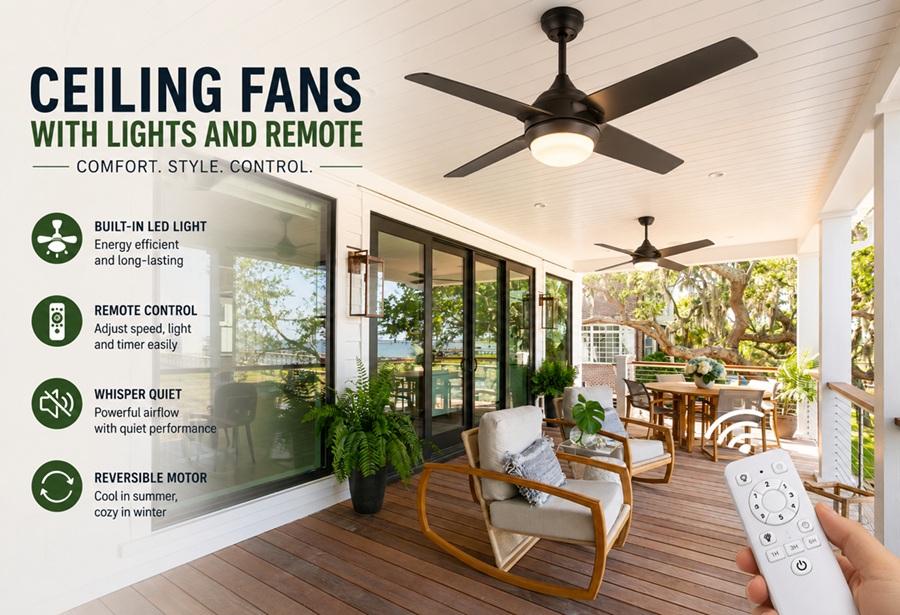

Ceiling fans with lights and remote control combine three jobs in one fixture: they cool a room, light it, and let you control both wirelessly without getting up or wiring a wall switch. The best choice pairs an efficient LED light kit with a correctly sized fan for your room and a remote or smart control that runs the fan speed and lighting from your hand or your phone. For most rooms, that means a fan sized to the space, a dimmable LED, and a remote or app that fits how you like to live.
These all-in-one fixtures have become the default for bedrooms, living rooms, and more, because they deliver comfort, illumination, and convenience together. But the range is huge, and the details, light type, remote style, size, and airflow, decide whether you love it. This guide walks through everything you need to choose a ceiling fan with lights and a remote that suits your room and your habits.
| What it is | A ceiling fan with a built-in light and wireless control |
| Light type | LED is the efficient, long-lasting standard |
| Control options | Handheld remote, wall remote, or smart app/voice |
| Key sizing factor | Blade span matched to room size |
| Dimming | Look for dimmable light and multiple fan speeds |
| Best for | Bedrooms, living rooms, and family spaces |
| Airflow measure | CFM – higher moves more air |
| Bonus feature | Reversible motor for year-round use |
Why Choose a Fan With Light and Remote
The appeal is efficiency of space and convenience. A single ceiling fixture provides both airflow and light, which is ideal in rooms without much ceiling real estate or where you do not want separate lights and fans competing overhead. Adding a remote removes the need to fish for a pull chain or install extra wall switches, so you control everything from the sofa or bed.
That convenience is more than a luxury. A remote or smart control lets you fine-tune the fan speed and dim the lights to suit the moment, from bright and breezy while cleaning to dim and gentle at bedtime. For rooms without existing switch wiring for a fan, a remote-controlled model can also be simpler to set up, since it avoids running new switch legs.
Choosing the Light Kit
The lighting is half the fixture, so it deserves real attention. LED is the clear choice today, running cool, lasting for years, and sipping energy compared with older bulbs. Beyond the technology, consider the color temperature and whether it dims.
- Favour LED for efficiency, low heat, and long life
- Choose a warm-to-neutral color, around 2700K to 3000K, for living spaces
- Look for a dimmable light so one fixture serves bright and cozy moods
- Consider the brightness in lumens to match the room’s needs
- Check whether the light is integrated or uses replaceable bulbs
Remote and Smart Control Options
Control is where these fans really differ, and the right option depends on how hands-free you want to be. There are three broad choices, from a simple handheld remote up to full smart integration.
| Control Type | How It Works | Best For |
| Handheld remote | A dedicated remote for fan and light | Simple wireless control |
| Wall-mounted remote | A remote that sits in a wall cradle | A switch-like feel without lost remotes |
| Smart control | App and voice via home systems | Hands-free, schedules, automation |
Smart-enabled fans add genuinely useful tricks: setting a schedule so the fan runs at night, adjusting from your phone before you get home, or using voice commands so you never reach for a switch. If you already use a smart-home system, a compatible fan slots right in, while a straightforward handheld remote is perfectly good for those who just want easy wireless control.
Getting the Size Right
A fan only cools well if it is sized to the room, since blade span determines how much air it moves. Too small and it cannot circulate a large space; too large and it overwhelms a small one. Use the room’s square footage as your guide when choosing the blade span.
| Room Size | Suggested Blade Span | Example Rooms |
| Small (up to ~75 sq ft) | About 29 to 36 inches | Bathrooms, small offices |
| Medium (up to ~175 sq ft) | About 42 to 48 inches | Bedrooms, kitchens |
| Large (up to ~350 sq ft) | About 52 to 56 inches | Living and family rooms |
| Very large (350+ sq ft) | 60 inches or more, or two fans | Great rooms, open plans |
Airflow, Motors, and Year-Round Use
Beyond size, airflow is measured in CFM, or cubic feet per minute, with higher numbers moving more air, which is worth checking if strong cooling matters. The motor type affects this too: modern DC motors tend to be quieter, more energy-efficient, and offer more speed settings than traditional AC motors, though they can cost more. A reversible motor is a feature worth having, letting the fan run one way to cool in summer and the other way to gently circulate warm air in winter, which makes the fan useful all year.
Installation Tips
Installing a ceiling fan with a light is heavier and more involved than swapping a light fixture, so a few points matter. The ceiling box must be a fan-rated brace box capable of supporting the fan’s weight and motion, since a standard light box is not sufficient. Getting the height right ensures safe clearance and good airflow, using a downrod for high ceilings and a flush or low-profile mount for low ones. Because the work involves fixed wiring and secure structural mounting, many people hire a qualified electrician, which is the safest choice if you are not comfortable with electrical work.
Frequently Asked Questions
What size ceiling fan do I need for my room?
Match the blade span to the room: roughly 29 to 36 inches for small rooms, 42 to 48 inches for bedrooms, 52 to 56 inches for living rooms, and 60 inches or more for very large spaces. Correct sizing is what makes a fan cool effectively.
Are LED ceiling fan lights better?
Yes. LED lights run cool, last for years, and use far less energy than older bulbs. Look for a dimmable LED in a warm-to-neutral color so the fixture works for both bright tasks and relaxed evenings.
Can I add a remote to an existing ceiling fan?
Often yes, using a universal ceiling fan remote kit that installs in the fan canopy. That said, buying a fan that comes remote-ready or smart-enabled is simpler and avoids compatibility guesswork.
What is a reversible motor for?
A reversible motor lets the fan spin both directions: one way pushes cool air down in summer, and the other gently circulates warm air that collects near the ceiling in winter, making the fan useful all year.
Do I need a special ceiling box for a fan?
Yes. A ceiling fan needs a fan-rated brace box built to support its weight and movement, not a standard light-fixture box. Using the correct box is essential for safety, which is one reason many hire an electrician.
Mistakes to Avoid When Buying
A few common errors turn an exciting purchase into a disappointment, and they are easy to sidestep once you know them. The biggest is getting the size wrong, either choking a large room with a small fan or overpowering a cozy space with an oversized one. Measuring the room and matching the blade span before you fall for a design prevents this, since even the most beautiful fan fails if it cannot move the right amount of air.
The other frequent misstep is overlooking the details that shape daily use. Buying a fixture whose light is not dimmable leaves you stuck at one brightness, while ignoring the control type can mean a clumsy setup that annoys you every day. It also pays to check the ceiling height and choose the correct mount, a downrod for tall ceilings or a flush mount for low ones, so the fan sits at the right height for both safety and airflow.
- Choosing a blade span that does not match the room size
- Overlooking whether the light dims
- Ignoring the control type and how you will actually use it
- Forgetting to match the mount to your ceiling height
- Using a standard box instead of a fan-rated brace box
- Skipping the reversible-motor feature for year-round use
Final Thoughts
A ceiling fan with lights and a remote is one of the most practical fixtures you can add to a room, delivering cooling, lighting, and effortless control in a single unit. Focus on getting the size right for your space, choose a dimmable LED light and the control style that fits your life, from a simple remote to full smart integration, and look for a reversible motor for year-round value. Install it on a proper fan-rated box, and you have a fixture that keeps a room comfortable and well lit at the touch of a button.