
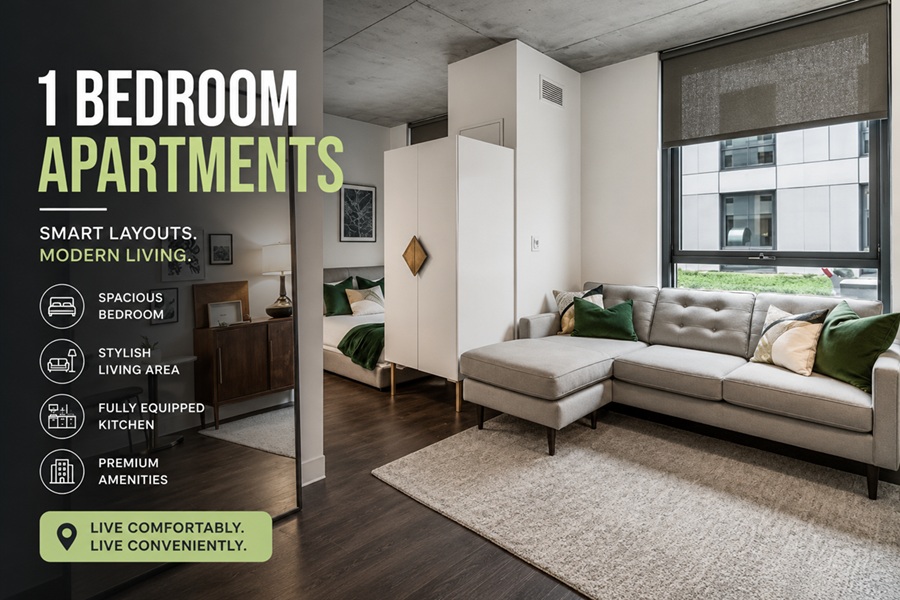
Tag: real estate

  • 1 Bedroom Apartments: Size, Cost and How to Choose the Right One

    1 Bedroom Apartments: Size, Cost and How to Choose the Right One

    A one-bedroom apartment is a unit with a single separate bedroom, plus its own living area, kitchen, and bathroom. That separation is the whole point: unlike a studio, the sleeping space has its own room and door, so your bed is not part of the living room. Most one-bedrooms fall somewhere between roughly 550 and 800 square feet, which makes them a comfortable fit for singles, couples, and anyone who works from home and wants a little breathing room.

    If you are deciding whether a one-bedroom is right for you, the quick answer is that it offers the best balance of privacy, cost, and space for one or two people. You get a real bedroom without paying for a second one you may not need. This guide covers typical sizes, who these units suit, what drives the rent, and how a one-bedroom stacks up against a studio or a two-bedroom.

    Definition One separate bedroom plus living, kitchen, and bath
    Typical size About 550 to 800 square feet
    Best for Singles, couples, and remote workers
    Key advantage Private bedroom separate from living space
    Rent vs studio Usually higher than a studio
    Rent vs 2-bedroom Usually lower than a two-bedroom
    Common layouts Open-plan living with a distinct bedroom
    Storage Varies; closets are a key thing to check

    What Defines a One-Bedroom

    The defining feature is a separate, enclosed bedroom. Everything else, the living room, kitchen, and bathroom, supports that private sleeping space. Some one-bedrooms have an open-plan living and kitchen area, while others keep the kitchen more separate, but the bedroom is always its own room.

    This is what sets it apart from a studio, where a single open space serves as bedroom, living room, and kitchen all at once. The door on a one-bedroom is small in size but big in daily comfort.

    Typical Size and Layout

    Square footage varies by city and building age, but the range is fairly consistent. Newer builds sometimes trade a bit of size for better amenities, while older units may feel roomier but dated.

    • A bedroom large enough for a queen bed and a dresser
    • A living area that doubles as a lounge and, often, a workspace
    • A kitchen ranging from a galley to a small open layout
    • One full bathroom
    • Closet space that is worth checking closely before you sign

    Who a One-Bedroom Suits

    These apartments are the workhorse of the rental market for good reason. A single person gains a dedicated bedroom and a separate space to relax or host. Couples get enough room to share comfortably without the cost of a second bedroom. Remote workers often use the living area or a corner of the bedroom as an office, though those needing a true dedicated office may look at a two-bedroom.

    What Drives the Rent

    Factor Effect on Rent What to Watch
    Location Biggest single factor Central areas cost more
    Size and layout Larger units cost more Usable space over raw footage
    Building age New often costs more Amenities vs charm
    Amenities Adds to rent Only pay for what you use
    Floor and view Can raise price Higher floors often pricier

    One-Bedroom vs Studio vs Two-Bedroom

    Choosing the right size is mostly about privacy versus budget. Here is how the three common options compare.

    Type Space Best For
    Studio One open room Solo renters on a budget
    One-bedroom Separate bedroom Singles and couples
    Two-bedroom Two bedrooms Roommates, families, home offices

    How to Choose the Right One

    When you tour a one-bedroom, look past the fresh paint and picture your actual life in the space. Bring a short mental checklist so you compare units fairly rather than on first impressions.

    • Check that the bedroom fits your bed and furniture with room to move
    • Test the storage; a shortage of closets is a common regret
    • Note natural light and window placement in each room
    • Listen for noise from neighbours, hallways, and the street
    • Confirm what is included in rent, from utilities to parking

    Making a One-Bedroom Feel Bigger

    Even a modest one-bedroom can live large with a few tricks. Keep the palette light and consistent so the eye flows through the space. Use multi-purpose furniture, like a storage ottoman or a bed with drawers, to cut clutter. Mirrors bounce light and add depth, and vertical shelving draws the eye up, making ceilings feel higher and floors less crowded.

    Furnishing a One-Bedroom Well

    The difference between a cramped one-bedroom and a comfortable one usually comes down to furniture choices rather than square footage. Scale is everything: an oversized sectional that would suit a house swallows a small living room, while pieces sized to the space leave room to breathe. Choose furniture that pulls double duty, so each piece earns its footprint.

    In the bedroom, a bed frame with built-in storage reclaims space that would otherwise be lost under the mattress. In the living area, a slim console or a nesting coffee table keeps things flexible for guests. If you work from home, a compact desk that tucks into a corner or folds away preserves the room’s primary function as a place to relax rather than a full-time office.

    • Pick a bed with drawers or lift-up storage underneath
    • Choose a sofa scaled to the room, not the biggest you can find
    • Use a folding or wall-mounted desk if you need a workspace
    • Add floating shelves to gain storage without eating floor space
    • Keep window treatments light to preserve natural brightness

    Questions to Ask Before You Sign

    A great tour can hide practical details that shape daily life, so ask the right questions before committing. Clarify exactly which utilities are included and which you pay separately, since that changes the true cost of the rent. Ask about parking, guest policies, and how maintenance requests are handled, because a slow-to-respond landlord turns small problems into big frustrations.

    It also pays to ask about the lease terms directly: the length, the renewal process, any rent-increase history, and the penalty for breaking the lease early. Knowing these upfront protects you from unwelcome surprises and helps you compare two similar units on more than just the headline rent.

    Frequently Asked Questions

    How big is a typical one-bedroom apartment?

    Most land between about 550 and 800 square feet, though this varies by city and building. Focus on how usable the layout is rather than the raw number.

    Is a one-bedroom worth it over a studio?

    If you value a separate, private bedroom and can afford the higher rent, most renters find the upgrade well worth it for daily comfort and the ability to host without your bed on display.

    Can two people live comfortably in a one-bedroom?

    Yes, couples commonly share one-bedrooms comfortably. The key is enough living space and storage, so pay close attention to closets and the size of the main room during your tour.

    Do one-bedrooms work for remote work?

    Often, yes, by carving out a workspace in the living area or bedroom. If you need a fully separate, quiet office with a door, a two-bedroom may serve you better.

    Are one-bedrooms a good value?

    For one or two people, they usually offer the best balance of privacy and cost in the rental market. You get a real, separate bedroom without paying for a second room you may not use, which is why they are among the most sought-after units almost everywhere.

    Common One-Bedroom Regrets to Dodge

    A little foresight during your search prevents the frustrations renters most often mention after moving in. The biggest is storage: a one-bedroom with too few closets forces you into bulky furniture that eats the space you were trying to save. Measure your largest pieces before signing so you know they will fit through doors and into rooms.

    Noise is the other frequent regret. A unit that seems peaceful at midday can be loud in the evening, so try to visit at different times or ask about the building’s soundproofing and neighbours. Finally, confirm the true monthly cost by adding up utilities, parking, and any fees on top of the base rent, so the apartment that looked cheaper does not turn out to cost more once everything is included.

    Final Thoughts

    A one-bedroom apartment remains the sweet spot for many renters because it delivers a private bedroom and a real living space without the cost of a second room. Tour with a checklist, prioritize storage and usable layout over raw square footage, and use light and smart furniture to make the space feel open. For singles and couples who want comfort and value in one package, it is hard to beat.