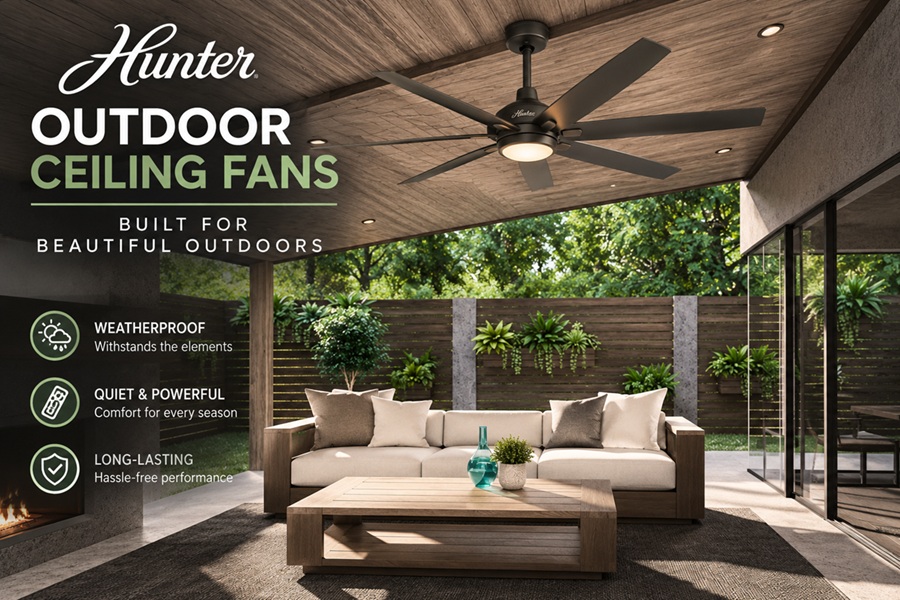

Hunter outdoor ceiling fans are weather-ready fans built to keep porches, patios, and pergolas comfortable, and the single most important thing to get right is the rating: damp-rated fans suit covered spaces protected from direct rain, while wet-rated fans, built with sealed motors and corrosion-resistant finishes, can handle uncovered areas exposed to rain. For coastal homes, Hunter’s salt-resistant WeatherMax models add protection against corrosive sea air. Match the rating to your space and the fan will run reliably for years instead of rusting or failing.
Hunter is one of the most established names in ceiling fans, and its outdoor line spans a wide range of sizes, finishes, and features, with or without lights and remotes. Choosing well means understanding the ratings, picking the right blade span for your area, and deciding on lighting and controls. This guide walks through all of it so you can select the right Hunter outdoor fan with confidence.
| Brand | Hunter Fan Company |
| Key decision | Damp vs wet vs salt-resistant rating |
| Damp-rated | Covered spaces: porches, sunrooms, patios under cover |
| Wet-rated | Uncovered areas exposed to rain, pergolas |
| WeatherMax® | Wet plus salt-resistant for coastal homes |
| Blade spans | Small up to 60 inches and larger |
| Options | With or without LED lights; remote compatible |
| Finishes | White, matte black, bronze, nickel, and more |
| Bonus | All outdoor models can be installed indoors too |
Understanding the Ratings
The rating is the foundation of any outdoor fan purchase, because installing the wrong type leads to rust, drooping blades, and electrical problems. Hunter builds three tiers for different levels of weather exposure, and matching yours is essential for safety and longevity.
| Rating | Best For | Exposure Handled |
| Damp-rated | Covered patios, porches, sunrooms | Humidity and moisture, not direct rain |
| Wet-rated | Uncovered patios, pergolas | Direct rain and heavy moisture |
| WeatherMax® | Coastal and seaside homes | Rain plus corrosive salt air |
The simple rule: if the spot ever gets rained on directly, you need a wet-rated fan. If it is fully covered and only deals with humidity and the occasional splash, a damp-rated fan is fine, and these also work beautifully in humid indoor rooms like bathrooms and laundry rooms. Near the ocean, step up to a salt-resistant WeatherMax model so sea air does not corrode the finish.
Choosing the Right Blade Span
Size drives how much air a fan moves, so match the blade span to your space. A fan that is too small will not cool a large patio, while an oversized one can overwhelm a small porch. Hunter offers spans from compact up to sixty inches and beyond for wide, open areas that need powerful airflow.
- Small porches and balconies suit compact fans under about 44 inches
- Standard patios and covered decks work well with 44 to 54 inch fans
- Large, open outdoor areas benefit from 56 to 60 inch or larger fans
- Higher ceilings may need a downrod to position the fan at the right height
- Low ceilings call for a low-profile or flush mount for safe clearance
Lights, Remotes, and Smart Control
Hunter outdoor fans come with or without lighting, and adding a weather-safe LED light kit turns a fan into a source of ambient or task light that also saves energy. For controls, many models are remote compatible, and outdoor-appropriate remotes use damp-rated receivers designed for covered spaces, letting you adjust speed and lighting without a wall switch.
Beyond basic remotes, Hunter offers smart-enabled fans that connect to home systems for app and voice control, so you can run the fan and lights hands-free or on a schedule. If a clean look and effortless control matter to you, choosing a model that supports a remote or smart control from the start is easier than retrofitting later.
Finishes and Style
Because an outdoor fan is a visible feature of your patio or porch, finish matters. Hunter offers a broad palette, including fresh white, matte black, various bronzes, brushed nickel, and pewter tones, so you can match the fan to your outdoor décor and any existing fixtures. A helpful bonus is that every fan in the outdoor collection can also be installed indoors, which makes it easy to carry a consistent style from your living room out to the porch if you like a cohesive look throughout the home.
Installation Considerations
Outdoor fan installation follows the same principles as indoor, with a few extra points. The mounting box must be rated to support a ceiling fan’s weight and motion, and the wiring must be suitable for the location. Getting the height right matters for both safety and airflow, using a downrod on tall ceilings and a low-profile mount where clearance is tight. Because outdoor wiring and secure mounting can be tricky, many homeowners have a qualified electrician handle the installation, which is the safest route if you are not confident working with fixed wiring.
Frequently Asked Questions
What is the difference between damp and wet rated fans?
Damp-rated fans suit covered spaces protected from direct rain, handling humidity and occasional splashes, while wet-rated fans have sealed motors and corrosion-resistant finishes to withstand direct rain in uncovered areas. If the spot gets rained on, choose wet-rated.
Can I use a Hunter outdoor fan indoors?
Yes. All of Hunter’s outdoor fans can be installed indoors, and their moisture resistance also makes damp-rated models a good choice for humid indoor rooms like bathrooms and laundry rooms.
What size outdoor ceiling fan do I need?
Match the blade span to the space: compact fans for small porches, 44 to 54 inches for standard patios, and 56 to 60 inches or larger for wide, open areas. Bigger spaces need bigger spans for effective airflow.
Do Hunter outdoor fans come with remotes?
Many are remote compatible, using damp-rated receivers suited to covered outdoor spaces, and some support smart control for app and voice operation. Choosing a remote or smart-ready model upfront is easier than adding it later.
What is WeatherMax?
WeatherMax is Hunter’s technology for wet-rated fans that are also salt-resistant, engineered to resist rust and corrosion in coastal environments. It is the right choice for seaside homes where salt air would damage a standard finish.
How high should an outdoor ceiling fan be mounted?
Mount it with ample clearance below the blades and enough distance from the ceiling for good airflow. Use a downrod on tall or sloped ceilings and a low-profile mount where clearance is tight, always keeping blades safely out of reach.
Can outdoor ceiling fans have light kits and remotes?
Yes. Many Hunter outdoor fans offer weather-safe LED light kits and support remotes with damp-rated receivers for covered spaces, and some are smart-enabled for app and voice control, so you get both light and wireless convenience outdoors.
Placement and Care for a Long Life
Even the right-rated fan performs better with thoughtful placement. Center the fan over the main seating or dining area of your patio or porch so the breeze reaches where people actually gather, and mount it at a safe, effective height, generally with ample clearance below the blades and enough distance from the ceiling for good airflow. On a covered porch, position matters less for weather but still shapes comfort, while on an exposed patio a wet-rated fan gives you freedom to place it wherever the layout calls for.
Outdoor fans face dust, pollen, and weather, so light maintenance keeps them looking and working their best. Wipe the blades periodically to prevent grime buildup that can unbalance them, check that mounting hardware stays snug over time, and clean the finish gently to protect its corrosion resistance. In coastal areas especially, rinsing salt residue off the finish now and then helps even a salt-resistant fan last longer. A few minutes of care each season adds years to an outdoor fan’s life.
- Center the fan over the main seating or dining zone
- Mount at a safe height with good blade clearance
- Wipe blades regularly to keep them balanced
- Check mounting hardware stays tight over time
- Rinse salt residue off finishes in coastal areas
Final Thoughts
A Hunter outdoor ceiling fan can transform a patio or porch into a cool, comfortable retreat, but the whole thing hinges on choosing the right rating for your exposure. Go damp-rated for covered spaces, wet-rated for anywhere the rain reaches, and WeatherMax for coastal salt air. Size the blade span to your area, add an LED light kit and a remote or smart control if you want convenience, and match the finish to your style. Get those choices right and you have a fan that looks great and lasts for years outdoors.